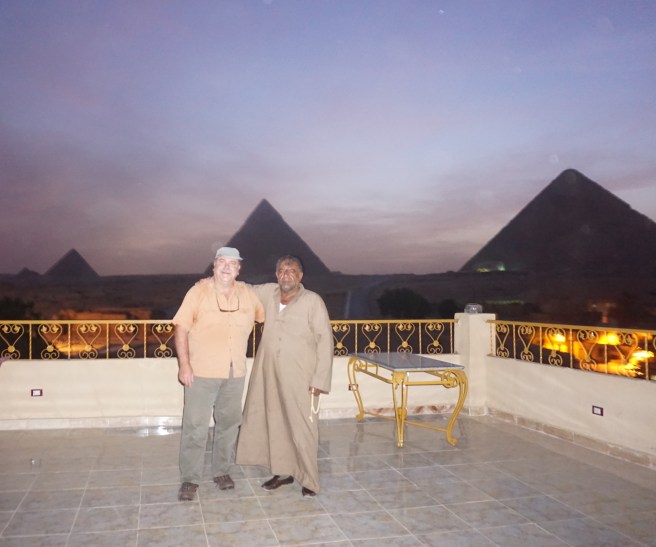
Author: abackpackandadaysack
Yes, pics
Abdoula
Allahu Akbar
Or………..Well, I Don’t Think I Will Try That Again……
I have said that many times in my life, and I wonder why I still try doing new things. (The older I get, the more I enjoy fishing).
I said that after bungie jumping off a 280 foot high bridge. And after jumping out of an airplane. And after hiking 45 miles in the Himalayas…..and…and….
Today, I will add riding a camel to the list.
It is not easy. When they stand up – the rear haunches first – then up on the front legs – you think you are going to tumble off head first. And when they go downhill or stop and lay down – front legs first – then the rear haunches – it scared the living shit out of me.
Here I was, lumbering through the sand around the pyramids, rocking back and forth – about 8 feet above the ground on a camel about 2 feet taller than the ones Abdoula and Luis were on.
The big man gets the big camel. Sounds like something Trump would say……..
Looking down at the sand I thought repeatedly that if/when I fell off, at least it would be a soft landing after a long fall – as long as my foot did not get caught in the stirrup, which once happened when I fell off a horse. Maybe just a broken arm or leg I thought. But when we went downhill and it was nothing but hard rock, I constantly thought WTF am I doing? I envisioned head injury, internal injury, or worse……
When I heard the camel handler say “Lean back. Lean back” my blood pressure would go up 40 points, and I repeatedly thought about my weight, my age and my flight insurance. Broken bones at a minimum and a long and painful flight home to end my walkabout. Well, I thought, at least I am close to hospitals and the airport.
We boarded the beasts at 8:30 AM and I finally got off that damed thing at 10 AM.
“Allahu Akbar, Allahu Akbar” I murmured softly as I got both my feet back on the sand at the end of the ride – about 100 feet from the Sphinx.
From the web:
Allahu Akbar. The phrase is commonly used by Muslims worldwide and is generally translated as “God is great.” It’s used in many contexts in Muslim societies — during prayer and in the call to prayer, to express amazement or sorrow or to pronounce determination. To most familiar with Islamic practices, the phrase is rather familiar and doesn’t carry an ounce of extremism to it.
Often in Muslim societies, the phrase is used as an alternative to applause, most often in religious settings. Someone will shout, “Takbir,” and the crowd responds, “Allahu akbar.” The phrase blasts from minarets of mosques five times a day in countries where the call to prayer is amplified throughout the streets.
I had met Luis at breakfast. Hispanic, a naturalized U.S. citizen, living and working in Chicago as a mid level manager and traveling alone. He arrived in Giza last night. His family is from Oaxaca, the only place in Mexico I would return to without hesitation. We talked travel over breakfast and he eagerly accepted the invitation to join me for a camel ride with Abdoula around the pyramids today. When he said “Travel is the best use of my money” I knew we would get along just fine.
Luis has been to New Zealand, England, Costa Rica, Australia, etc.
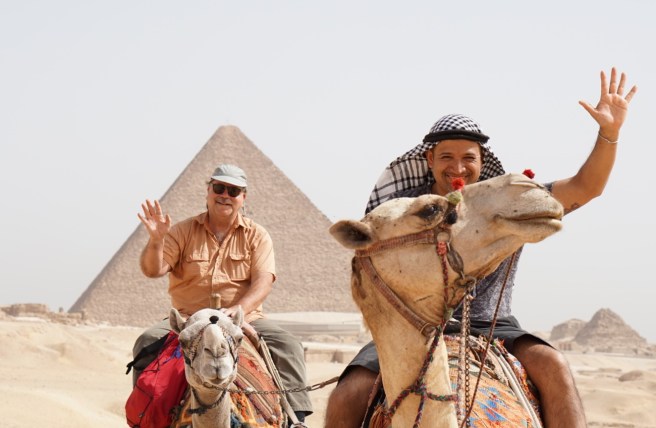
Abdoula says “Wave for the camera. Say cheese”. I am thinking please take me back to the guest house…….
After the camel ride, we shared a few beers on the rooftop patio and we agreed to have dinner and watch the pyramid light show together tonight.
It is hot today – 104F.
Allahu Akbar.
Namaste.
Wiki says…..
The pyramid necropolis of Khufu was erected at the north-east section of the plateau of Giza. It is possible that the lack of building space, the lack of local limestone quarries and the loosened ground at Dahshur forced Khufu to move north, away from the necropolis of his predecessor Sneferu. Khufu chose the high end of a natural plateau, so that his future pyramid would be widely visible. Khufu decided to call his necropolis Akhet-Khufu (meaning “horizon of Khufu”).[36][37][38][39]
The Great Pyramid has a base measurement of ca. 750 x 750ft (≙ 230.4 x 230.4 m) and today a height of 455.2 ft (≙ 138.8 m). Once it had been 481 ft (≙ 146.5 m) high, but the pyramidion and the limestone casing are completely lost due to stone robbery. The lack of the casing allows a full view to the inner core of the pyramid. It was erected in small steps by more or less roughly hewn blocks of dark limestone. The casing was made of nearly white limestone. The prisms for the casing were finely polished at their displaying site. The complete freshly set casing made the pyramid shimmer in bright natural lime white. The pyramidion could have been covered with electrum, but up to this day there is no archaeological proof for that. The inner corridors and chambers have walls and ceilings made of polished granite, one of the hardest stone known at Khufu’s time. The used mortar was a mixture of gypsum, sand, pulverized limestone and water.[36][37][38]
The monument has its original entrance at the northern side and contains three chambers: at the top, the burial chamber of the king (king’s chamber), in the middle, the statue chamber (erroneously called queen’s chamber), and an unfinished subterranean chamber (underworld chamber) under the foundation of the pyramid. Whilst the burial chamber is identified by its large sarcophagus made of granite, the use of the “queen’s chamber” is still disputed – it might have been the serdab of the Ka-statue of Khufu. The subterranean chamber remains mysterious. It was left unfinished; a tight corridor heading south at the western end of the chamber and an unfinished shaft at the eastern middle might point out that the subterranean chamber was the eldest of the three chambers and that the original building plan contained a simple chamber complex with several rooms and corridors. But for some unknown reasons the works were stopped and two further chambers had been built inside the pyramid. Remarkable is the so-called Great Gallery leading to the king’s chamber: It has a niched ceiling and measures 28.7 ft in height and 151.3 ft in length. The gallery has an important static function, it diverts the weight of the stone masses above the king’s chamber into the surrounding pyramid core.[36][37][38]
Khufu’s pyramid was surrounded by an enclosure wall, each wall 33 ft (≙ 10.1 m) in distance from the pyramid. At the eastern site, directly in front of the pyramid, the mortuary temple was built. Its foundation was made of black basalt, a great part of which is still preserved. Pillars and portals were made of red granite, the ceiling stones made of white limestone. Today nothing is left over from the temple. From the mortuary temple a 0.43 miles long causeway once headed to the valley temple. The valley temple was possibly made of the same stones as the mortuary temple, but since even the foundation is not preserved, the original form and size of the valley temple remain unknown.[36][37][38][39]
At the eastern site lies the East Cemetery of the Khufu-necropolis, containing the mastabas of princes and princesses. Three small satellite pyramids, belonging to the queens Hetepheres (G1-a), Meritites I (G1-b) and possibly Henutsen (G1-c) were erected at the south-east corner of Khufu’s pyramid. Close behind the queen’s pyramids G1-b and G1-c the cult pyramid of Khufu was found in 2005. At the southern site lie some further mastabas and the pits of the funerary boats of Khufu. At the western site lies the West Cemetery, where the highest officials and priests were interred.[36][37][38][39]
Pics???
Nope. Not yet. But I took some.
Inet is ~ .1 to .3 MB/second upload speed and the connection drops out after about 30 seconds. It might take minutes to post an entry like this.
With a good connection I could search the web for info to copy and paste and make the blog much more interesting. It reminds me of the problems I had posting in Myanmar, Nepal and Tibet.
But I had a nice dinner at Abdoula’s home, smoked some apple/tobacco in a hooka, stepped around piles of horse shit – literally, saw how ancient Egyptians made paparyus paper, drank tea, fed the cats my chicken bones after dinner, watched the pyramid light show, played with Abdoula’s grandkids (they were facinated by my ponytail), met one daughter and 2 sons and had a generally relaxing, social and enjoyable evening.
When I Met Abdoula
I had walked only 5o feet from my guest house.
He encouraged me to step inside his shop, which primarily sold papyrus paper Egyptian prints, but the store also had some nice perfumed oils. We talked a bit and I was soon offered and accepted my second cup of tea of the morning. I had walked less than a block.
Abdoula, the father of five and 60, has these two large growths on his face and he reminded me of Aaron Neville. He was persistent about me buying some lotus oil or a papyrus print or hiring him as a guide. “Tomorrow, maybe, later. We will see. I will come back. Let me think about it”.
He was as persistent as I was evasive. I call it the traveler’s dance.
Back and forth, over and over, round and round.
Abdoula was not the owner of the shop, but the cousin of the owner. The owner was Gouda, and when I met Gouda several hours later after walking around, I was more than impressed when – after telling him I was from Oregon – he mentioned the Grateful Dead and said that he was good friends with the late Ken Kesey. If you do not know about Ken, take a few minutes and read a little about him on wiki.
Oh, that guy. I guess I have heard of him. That was a great movie……..
Gouda gave me black market rates – a 10% premium in my favor – on the exchange of $100 USD to Egyptian pounds – 1 to 9.5 – and then later introduced me to Hassan, who took me 6 blocks through the narrow backstreets and alleys of Giza – by car – dodging potholes, donkey carts and storefronts – to purchase several beers.
I was shown the guest house rooms that Gouda owns above the papyrus shop and they are 3 times more spacious, $10.00 cheaper and have softer mattresses. The rooftop view of the sphinx and the pyramids is unbelievable. I think I will stay here in Giza for a few additional days and enjoy the hospitality of Gouda’s guest house after my four nights are complete at Pyramids View Bed and Breakfast.
Speaking of breakfast, it was a days worth of food. Yogurt, 2 hard boiled eggs, filafals, bread, butter and jam, coffee, cheese, and more. I ate only half of what was presented.
After the beer run with Hassan, I sat in the lobby of the papyrus shop and sucked down a cold one and showed Hassan pictures of salmon and redwoods. When Abdoula returned from the mosque and mid day prayers, we again started the traveler’s dance. Tomorrow – 8 AM, camel ride, tour the pyramids, go inside the great pyramid, etc. etc. “Maybe, we will see, let me think about it”. As a last resort he invited me to have dinner at his home.
Now that was an offer I could not refuse.
So tonight, after watching the pyramid laser show from the rooftop of Gouda’s guest house, I will meet Abdoula at 8 PM and go to his home for dinner.
And, of course, I will go for the camel ride tour of the pyramids with him at 8 AM tomorrow.
Unable to Upload Any Pics…..
But I must say, those are some really, really, REALLLY big piles of rock on the hill just 1/2 mile away from my room.
Before I Even Arrived In Egypt……
I was experiencing the hospitality of Egypt from an outgoing, young, helpful, english fluent Egyptian named Moro.
In Vienna, as I was boarding the airport shuttle bus to my Cairo bound plane, I exchanged brief pleasantries with a man on the bus. He said he had come a long way today and was going home to Cairo. I asked him how far away was ‘a long way today’? (I was confident I could win the traveler bragging rights on distance traveled. Hell, I was flying half way around the earth). He had flown from D.C. today, after visiting his sister, one of several trips to visit her in Virginia that he makes every year. We had been on the same flight from Dulles.
I beat him by 5 air time hours and an additional 3000 miles. We connected immediately.
Within 30 seconds I was getting recommendations about places to visit. He gave me his phone number and email, then was showing me pics on his phone! Moro said I could call him anytime! Although I was dead tired, my first thought was “my first friend on my walkabout”.
The plane on last leg of the trip was nearly empty. There were multiple empty rows and most rows had only one person, but I sat in my own row and did not talk with Moro. I listened to music.
On the plane, I celebrated passing through Vienna for a second time by listening to some hometown music – Mozart. (I stayed in Vienna for one night about 15 years ago while traveling across Europe by train following two weeks of sightseeing in Poland).
Traveled a total of about 9000 air miles today and I am very tired. But it has been a good start.
Departing Vienna, we flew SE – over Slovenia, Croatia, Bosnia and Herzegovina, Serbia, Kosovo, F.Y.R. Macedonia and Greece but you could no see anything as there was heavy cloud cover until we got over the Aegean Sea north of Rhodes.
Since I left PDX 8:00 AM Saturday and was arriving in CAI at 2:00 PM Sunday (and I was feeling like a lonely boy out traveling on a weekend), I listened to Neil Young’s “Out On The Weekend” on the Harvest album.
Lyrics:
“Out On The Weekend”
Think I’ll pack it in
and buy a pick-up
Take it down to L.A.
Find a place to call my own
and try to fix up.
Start a brand new day.
The woman I’m thinking of,
she loved me all up
But I’m so down today
She’s so fine, she’s in my mind.
I hear her callin’.
See the lonely boy,
out on the weekend
Trying to make it pay.
Can’t relate to joy,
he tries to speak and
Can’t begin to say.
She got pictures on the wall,
they make me look up
From her big brass bed.
Now I’m running down the road
trying to stay up
Somewhere in her head.
The woman I’m thinking of,
she loved me all up
But I’m so down today
She’s so fine she’s in my mind.
I hear her callin’.
See the lonely boy,
out on the weekend
Trying to make it pay.
Can’t relate to joy,
he tries to speak and
Can’t begin to say.
We landed in CAI and Moro showed me where to purchase my 30 day VISA for $25.00 and followed me through customs and immigration. I opted for the “Nothing to Declare” lane and my backpack and day sack were prodded as though I was smuggling a baby or a live endangered species within each bag.
Gabriel, a retired Egyptian policeman, was standing with a Pyramids View Hotel sign as we exited Customs and he took me to the duty free shop where I picked up a bottle of tequila for $30.00 which I will enjoy on the hotel rooftop during the 7PM pyramid laser shows the next 4 nights.
First impression of Egypt in the airport parking lot? New cars, clean, efficient – not a third world appearance.
Traveling to Giza we would traverse Cairo. It had a soviet feel – thousands of 5 story apartment buildings, both lived in and under construction.
Malls, shopping centers – IKEA, Toyota, Honda, Victoria’s Secret. Lots of English signage. The highway had 4 or 5 lanes, but there were 6 or 7 lanes of traffic. Gabriel constantly goosed the gas and then braked – every 6 or 7 seconds – as we negotiated the freeway.
We crossed over the Nile – it did not look as wide as the Columbia where I usually fish – more like the Mississippi in St. Louis. Trash and garbage increased and soon there were piles, mounds and in places truck loads of debris on the shoulders of the freeway. Several piles were on fire. There were tire sellers/repairers and lemonade stands occasionally in the far right lane of the 5 lane freeway.
We stopped in the bridge over the Nile and I took some pics.
All My Bags Are Packed,
I’m Ready To Go….
So sings John Denver, as I find myself listening to “Leaving On A Jet Plane”.
Departing PDX at 8:00 AM tomorrow. PDX to Dulles to Vienna to Cairo in 20+ hours, with aisle seats the entire route.
Soon I will be staying on the edge of metropolitan Cairo, population 17 million.
I arrive at 2 PM Sunday. I have arranged a ride from the airport to the hotel.
Check out this link: http://www.pyramidsviewinn.com
Wiki says:
Cairo (/ˈkaɪroʊ/ kye-roh; Arabic: القاهرة, al-Qāhirah, Coptic: ⲕⲁϩⲓⲣⲏ, Kahire) is the capital and largest city of Egypt. The city’s metropolitan area is the largest in the Middle East and the Arab world, and 15th-largest in the world, and is associated with ancient Egypt, as the famous Giza pyramid complex and the ancient city of Memphis are located in its geographical area. Located near the Nile Delta,[1][2] modern Cairo was founded in 969 CE by Jawhar al-Siqilli (“the Sicilian”) of the Fatimid dynasty, but the land composing the present-day city was the site of ancient national capitals whose remnants remain visible in parts of Old Cairo. Cairo has long been a center of the region’s political and cultural life, and is nicknamed “the city of a thousand minarets” for its preponderance of Islamic architecture.
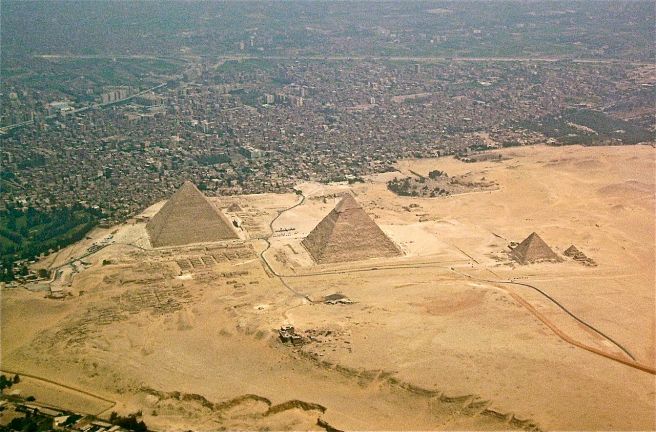
The first four nights I will be staying in Giza, on the edge of Cairo, one block to the east of the pyramid complex and 100 yards from the Sphinx. The hotel is American owned and had great reviews on TripAdvisor.


As an avid reader of all of Paul Theroux’s books on solo travel, the following quote often floats through my mind:
“Tourists don’t know where they’ve been, travelers don’t know where they’re going.”
So, I guess I am a traveler. After the first four nights, I have no reservations. I plan on getting a 30 day VISA for Egypt and then heading to Morocco and then north across Gibraltar to the Continent, then over to the UK and Ireland. There are several places in Britain that I want to have a pint of beer in a pub – in celebration and rememberance of my father and his younger brother – both B-17 Pilots that flew 35 missions over Europe in WWII……. More on that later.
I purchased travel insurance for a 90 day trip, so I guess that is the end game plan.
Stay tuned.
So….What’s On The Menu?…
Typical Food of Egypt
Typical Egyptian Dishes, Meals and Desserts
Egyptian cuisine and some of its recipes date back 5000 years and archeologists have even revealed the use of food as a means of payment during ancient times. Of course, there have been some adjustments to the dishes over the years, mainly with the addition of ingredients and styles taken from other cultures (note the dropping of alcoholic drinks has also been a part of this change).
Egyptian cuisine depends heavily on legumes such as beans and lentils as well as vegetables and onions making a regular appearance in most dishes. Vegetarians normally have no problem getting by in Egypt since meat has traditionally been expensive and thus less common. Around the Egyptian coast you will find more fish in the meals.
The Egyptian Bread Aish also forms part of most of the meals. Did you know that Aish is the Egyptian word for bread and also means life. Also, if you find there is no cutlery, it is common to use your bread to “spoon” the food.
Typical Egyptian Dishes
Aish – Aish is the Egyptian traditional pocket bread similar to pita bread. It is made by mixing wheat flour, water and salt then baked.
Aish baladi – same as above but it uses whole wheat bread.
Baba Ghanoush – Made from grilled eggplant that is peeled then mashed and mixed with tahini (see below), lemon juice, salt, pepper, parsley, cumin and dressed with olive oil. This dip has a smoky flavor and is best served with pita bread.
Baba Ghanoush – Typical Egyptian Food
Basbousa – A sweet semolina cake which is soaked in a syrup that has a floral scent (made from rose water and sometimes lemon and honey).
Beide Hamine – Almost like hard-boiled eggs though smoother and creamier due to them slowly simmering for 6-8 hours.
Bram rice – Rice made with milk which is stuffed with chicken liver.
Falafel – (or ta’amiya) is a well-known dish in the Middle East thought to have originated in Egypt. It consists of balls of fava beans (broad beans) or chickpeas that have been deep fried.
Fatta – a garlic and white vinegar flavored meat soup served with rice. Traditionally a Nubian dish, Fatta is usually prepared on special occasions such as weddings, a woman’s first pregnancy (baby shower) and as the main meal during the Eid al-Adha religious festival.
Feseekh (or Fesikh) – fermented, salted and dried gray mullet fish. It is normally eaten during the spring celebration of Sham el-Nessim.
Ful medames – Mashed Fava beans (broad beans) that are cooked with oil, chopped parsley, garlic, lemon juice and salt added to them. Traditionally eaten with pita bread and onions with some pickled vegetables and fresh rocket leaves on the side. At breakfast time you may find it accompanied by an egg.
Hamam Mahshi – (stuffed pigeon) This is similar to Mahshi (see below), though is made by stuffing rice, wheat or herbs into pigeon then grilled or roasted it.
Hummus bi Tahina – a dip made from chickpea and sesame. It is usually served with grilled or toasted bread. It can also be used as a spread or in a sandwich.
Kofta – Sometimes called Kefta, these are spiced meatballs (looking more like small sausages than balls) often served on a skewer.
Kibda – fried liver (beef) usually sold from a cart.
Koshary – (Also known as Kushari) Considered one of the most famous dishes of Egypt, this vegetarian meal contains rice, spaghetti, macaroni, black lentils, chick peas, garlic, and is topped with a spicy tomato sauce (sometimes Chilli sauce) and fried onions. You will find Koshary being sold cheaply at street stalls and also in restaurants, some only specializing in this dish. So basically, you can’t leave Egypt without trying this.
Macaroni béchamel – Penne pasta with a layer of cooked spiced meat and onions and white (Béchamel) sauce.
Mahshi – (stuffed vegetables) A healthy vegetarian meal made by stuffing vegetables such as cabbage leaves, tomatoes, green peppers, aubergines, and courgettes with rice seasoned with herbs and spices. This is then placed in a pot and topped with tomato sauce and lemon.
Molokhia (or Molokheyyah) – A soup made from finely chopped mallow leaves mixed with ground coriander and garlic. It is a staple part of Egyptian food though is normally only eaten at home.. Sometimes chicken, lamb or rabbit is added to this greenish soup.
Roz meammar – milk, butter or cream, chicken stock or broth add to rice that has already been cooked which is then all baked together in an oven.
Samak mashwy – fish that has been marinated and then grilled. Typical dish of Alexandria.
Shawarma – This popular Middle Eastern sandwich is made from shaved goat, chicken, lamb, beef, or turkey. It is rolled in pita bread and tahini sauce. This meal has its origin in Laventine cuisine and was incorporated into Egyptian cuisine.
Tahini – sesame paste
Tehina – This dip is made from sesame tahini, mixed with lemon juice and garlic to make a dip or spread that is typically served with pita bread.
Tehina salad – This salad is made by mixing sesame butter, chickpeas, vinegar, lemon juice, pepper, cumin, parsley, and olive oil.
Torly – Baked squash, potatoes, carrots, onions, and tomato sauce served on a tray to make a meal.
Egyptian Desserts
Baklava – Layers of flaky pastry filled with chopped nuts and honey syrup.
Bouzat haleeb – Egyptian ice-cream (though more like milk sherbet than cream)
Halawa – a popular confection in Egypt made from sesame paste. It is normally sold in blocks (by weight)
Kishk – a cold yoghurt sauce.
Roz Be Laban – rice pudding with a hint of vanilla
Umm Ali – Layers of bread soaked in milk with raisins and sometimes topped with nuts. It is served hot.
 abackpackandadaysack
You must be logged in to post a comment.