Roseann RoseannAdanna Revisited

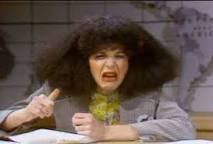
Last year while traveling in Turkey I wrote a blog called Rosanne RosannAdanna. I had a RosannaRosannAdanna experience in Egypt over the last 24 hours.
image

Yesterday Moro picked me up to take me to a shipping store, Aramex, so that I could ship home the 14 shirts, my books on Egypt and the other stuff that I had picked up or brought along that I no longer need on the next leg to Morocco.  We went to Aramex and Moro double parked out in front of the store. There are no parking garages in Egypt. You park anywhere you can.

I went inside and sat and sat and waited for 30 or 40 minutes for my number to be called while Moro stood out on the street and watched his car, making sure it did not get towed or got a boot put on the wheel. Finally my number was called and I went up to the agent and I said ‘I need a box.’ He looked at me quizzically. I called Moro on his phone and he came inside and I told him I and need a box to put all the stuff in. After five minutes the agent brought a box out and I started to put my things that I wanted to ship in the box.

He looked at the papyrus prints all rolled up in a shipping tube and he said ‘Let me see what’s in there.’ I showed him and he said no no cannot ship – might be an Egyptian antiquity. Next were the stone carvings I had of Nefertiti and King Tut. He said no no cannot ship might be antiquity. I had some other things, a carved scarab and other assorted carvings out of stone and he said no no cannot ship might be antiquity.

The agent basically wanted me to unpack everything that I had carried to the store and spread it all out on the floor and the desk for him to look at every single item. I told Morrow that I would rather not do it in front of 14 people in the store that maybe we should go to his house and I should pack only the things that I know I can ship and take the items that I cannot ship out of the box. So I packed everything up and went to Moro’s house where I unpacked everything sorted and re-boxed everything.

Next we went to a DHL store.  I went in to just get a quick quote on what it would cost to ship 8 kg or about 15 pounds of items to the United States. He told me $480.00, as in American dollars. I left frustrated and got in the car with Moro. He apologized repeatedly but I knew it was just the Egyptian way.  I did not blame Moro,  it’s just the  Egyptian way.

This morning I was talking to the hotel owner of the Osiris Hotel and I told him that now I must carry to Casablanca 20 extra pounds of crap-  15 extra shirts, my books on Egypt and other things that I just do not want to carry with me for the rest of my journey. I lamented about the high cost of shipping items to the United States. He said that he would take me to the Postal Service or the post office behind the train station in downtown Cairo and I could ship my items cheaper there. We set off in a cab with one of his helpers carrying the box of my clothing. We got to the post office, the owner negotiated and I paid roughly $130.00 to ship my items. The hotel owner explained to me the Egyptian way – like shipping items in Nepal – it is all about who you know and your connections.

I have no idea if my items are going by boat or airplane- or if they will be delivered in 4 days or 3 monrhs or not at all.  Lets just say they will arrive, inshallah.

The good news is that I will be able to travel to Casablanca much lighter tomorrow.

Like RoseanRoseannAdanna says “It is always something.”

It is especially true when traveling in foreign countries.


As I was typing and finishing this post, I received a call from Abdou at Venus in Luxor.  He wanted to know how I was doing, if everything was OK, when I would leave Egypt.

He cared for me and treated me like a brother, like many others on my 30 day journey in Egypt.  Many friendships, amazing hospitality and everyone always very willing to help – everyone from the hotel owner here at Osirius, to Sphinx Abdoul, Pyramid View Abdoul and, of course, my very good friend Moro.

On a bus ride today, the fare/ticket taker offered to cut my hair.  It was a nice gesture, but I declined.  He was being friendly.

30 days in Egypt was amazing.. Hope you were able to follow me on the journey.  If you have ever thought about visiting, I would be happy to,share with you my contacts. Be assured, they will treat you well and you will be safe.

The friendships, hospitality and assistance I received throughtou my journeies in Egypt make the problems seem so minor and insignificant.

Fly direct to Casablanca at 9:30 AM tomorrow on EgyptianAir.  17 hours from post time, but not before another night in Cairo with my friend Moro.  We meet at 8:30 PM.

Carpe Diem

Namaste
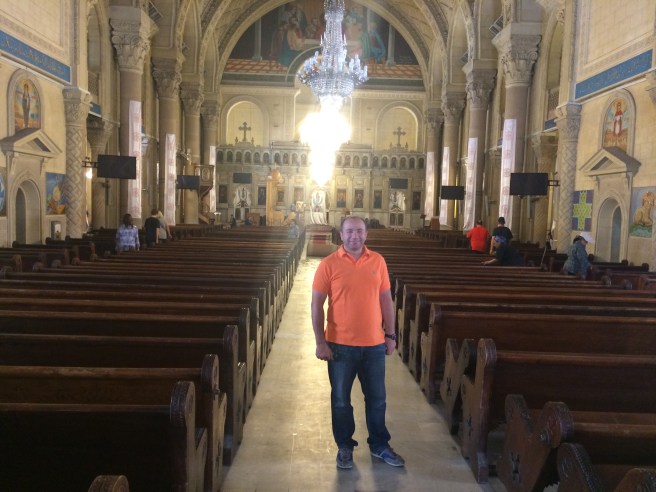
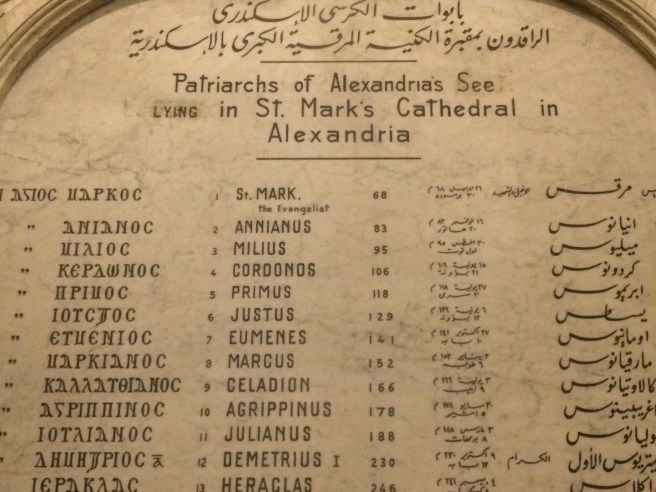
The Coptic Church of St. Mark. May 21, 2016

image

Moro

image
Saint Mark’s Coptic Orthodox Cathedral (Alexandria)

31.198290°N 29.899403°E
Location Mahatet el-Ramleh, Alexandria
Country Egypt
Denomination Coptic Orthodox Church of Alexandria
Website http://www.elmorkosia.net
History
Founder(s) Saint Mark
Dedication Saint Mark
Consecrated 60 AD.
Style Coptic
Saint Mark’s Coptic Orthodox Cathedral in Alexandria is the historical seat of the Pope of Alexandria, the head of the Coptic Orthodox Church.

The cathedral is said to stand on the site of the church founded by St. Mark the Evangelist in AD 60.

St. Mark the Evangelist (author of the second Gospel) has been connected with the city of Alexandria since earliest Christian tradition. Coptic Christians believe he arrived in Alexandria around AD 60 and stayed for about seven years.

During this time, Mark converted many to Christianity and performed many miracles. He is considered the founder of the church in Alexandria and the first Bishop of Alexandria. According to tradition, St. Mark was arrested during a festival of Serapis in AD 68 and martyred by being dragged through the streets. He was buried under the church he had founded.

Relics of Saint Mark

In 828, relics believed to be the body of St. Mark were stolen from Alexandria by Venetian merchants and taken to Venice.[1] Copts believe that the head of St. Mark remains in a church named after him in Alexandria, and parts of his relics are in St. Mark’s Cairo’s Cathedral. The rest of what are believed to be his relics are in the San Marco Cathedral in Venice, Italy.[2] Every year, on the 30th day of the month of Paopi, the Coptic Orthodox Church celebrates the commemoration of the consecration of the church of St. Mark, and the appearance of the head of the saint in the city of Alexandria. This takes place inside St. Mark Coptic Orthodox Cathedral in Alexandria, where the saint’s head is preserved.

The head of St. Mark was moved around a great deal over the centuries, and has been lost for over 250 years. Some of the relics from the body of St. Mark, however, were returned to Alexandria from Rome in 1968 during the papacy of Coptic Pope Cyril VI.

The present St. Mark’s Coptic Cathedral is of recent date, but is said to stand on the site of church founded by St. Mark himself.[3]

History of the Cathedral
Facade of the cathedral.
In AD 311, before the martyrdom of Pope Peter the Last of Martyrs, he prayed a last prayer on the grave of Saint Mark, the church was then a little chapel on the eastern coast[citation needed], and it contained bodies said to be of Saint Mark and some of his holy successors. The church was later enlarged in the days of Pope Achillas, the 18th Pope.

The church was greatly ruined in 641 when the Arabs invaded Egypt. In 680 Pope John III rebuilt the church. In 828, the body of Saint Mark was stolen by Italian sailors and was taken from Alexandria to Venice in Italy. However, Saint Mark’s head remained in Alexandria.

The church was destroyed again in 1219, during the time of the crusades, then it was rebuilt once more. Sixteenth-century French explorer Pierre Belon mentions the founding of the church in 1547.[4]

The church was pulled down during the French invasion of Alexandria in July 1798. The church was rebuilt and opened in 1819 by Pope Peter El Gawly in the time of Mohammed Ali Pasha. The church was renewed in the time of Pope Demetrius II and by the supervision of Bishop Marcos of El Behira in 1870. Between the years 1950–1952, in the time of Pope Yusab II, the church building was pulled down and another, larger building was built with reinforced concrete after the basilique style. The six marble pillars were transferred into the outer entrance of the church. The icon carrier was accurately cut into parts, each part given a number, and then it was cautiously returned to where it was originally. The two minarets were not pulled down as they were reinforced with concrete and were decorated with beautiful Coptic engravings. Two new bells – brought from Italy – were provided, one for each minaret.

Between 1985 and 1990, the church was widened from the western side after the former style with great accuracy, keeping the two minarets in their places, so the entire area of the church was doubled. The six pillars were transferred to the new western entrance of the church supervised by Pope Shenouda III.[5]


Wiki Says

Location Pharos, Alexandria, Egypt
Coordinates 31°12′50″N 29°53′08″E
Year first constructed c. 280 BC
Deactivated 1303/1323
Foundation Stone
Construction Masonry
Tower shape Square (below), octagonal (middle) and circular (top)
Height 393–450 ft (120–137 m)[citation needed]
Range 47 km (29 mi)

The Lighthouse of Alexandria, sometimes called the Pharos of Alexandria (/ˈfɛərɒs/; Ancient Greek: ὁ Φάρος τῆς Ἀλεξανδρείας), was a lighthouse built by the Ptolemaic Kingdom between 280 and 247 BC which was between 393 and 450 ft (120 and 137 m) tall.[citation needed] One of the Seven Wonders of the Ancient World, it was one of the tallest man-made structures in the world for many centuries. Badly damaged by three earthquakes between AD 956 and 1323, it then became an abandoned ruin. It was the third longest surviving ancient wonder (after the Mausoleum at Halicarnassus and the extant Great Pyramid of Giza) until 1480, when the last of its remnant stones were used to build the Citadel of Qaitbay on the site. In 1994, French archaeologists discovered some remains of the lighthouse on the floor of Alexandria’s Eastern Harbour.[1] The Ministry of State of Antiquities in Egypt has planned, as of late 2015, to turn submerged ruins of ancient Alexandria, including those of the Pharos, into an underwater museum.[2]
Three-dimensional reconstruction based on a comprehensive 2006 study
Pharos was a small island located on the western edge of the Nile Delta. In 332 BC Alexander the Great founded the city of Alexandria on an isthmus opposite to Pharos. Alexandria and Pharos were later connected by a mole[3] spanning more than three-quarters of a mile, which was called the Heptastadion (“seven stadia”—a stadium was a Greek unit of length measuring approximately 180 m). The east side of the mole became the Great Harbour, now an open bay; on the west side lay the port of Eunostos, with its inner basin Kibotos, now vastly enlarged to form the modern harbour. Today’s city development lying between the present Grand Square and the modern Ras al-Tiin quarter is built on the silt which gradually widened and obliterated this mole, and Ras al-Tiin represents all that is left of the island of Pharos, the site of the lighthouse at its eastern point having been weathered away by the sea.

The lighthouse was constructed in the 3rd century BC. After Alexander the Great died of a fever at age 32, the first Ptolemy (Ptolemy I Soter) announced himself king in 305 BC, and commissioned its construction shortly thereafter. The building was finished during the reign of his son, the second Ptolemy (Ptolemy II Philadelphus). It took twelve years to complete, at a total cost of 800 talents, and served as a prototype for all later lighthouses in the world. The light was produced by a furnace at the top, and the tower was said to have been built mostly with solid blocks of limestone. Strabo reported that Sostratus had a dedication inscribed in metal letters to the “Saviour Gods”. Later Pliny the Elder wrote that Sostratus was the architect, which is disputed.[4] In the second century AD the satirist Lucian wrote that Sostratus inscribed his name under plaster bearing the name of Ptolemy. This was so that when the plaster with Ptolemy’s name fell off, Sostratus’s name would be visible in the stone.[5]


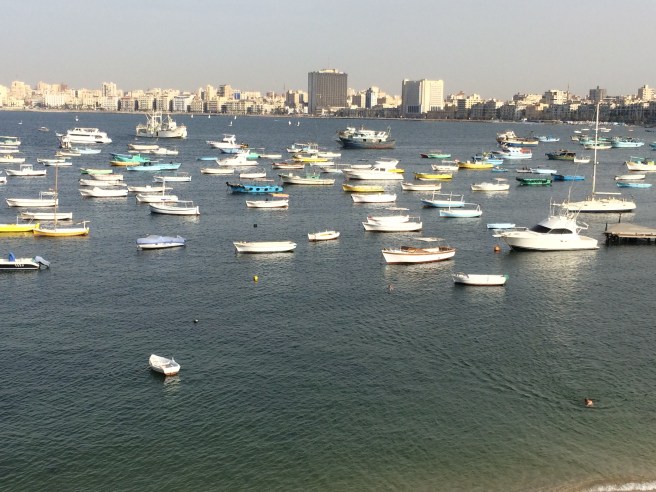
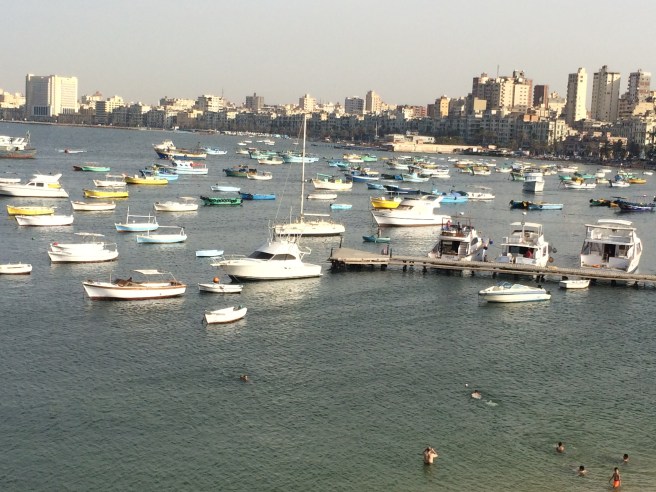
We ate lan unbelievable lunch 100 yards from the fortress that was built of stone from the collapsed lighthouse. We had sweeping views of the harbor of Alexandria and the city skyline over the water.

imageimage

Pics of lunch and a recap of the day to follow in next post.

Meat

I have wanted to make this post for 24 hours and thoughts keepin’ drifting around my dimented brain about something substantial, real, believable after my failed quest for where the Red Sea was parted.

I felt defeated.  A failure.  All this distance traveled, just to be disappointed.  Why am I here?

I needed comfort.  Something substantial, real, something to believe in, like hope.  Arabs would say inshallah or god willing.

I think about a pot of gold at the end of the rainbow.

But it hardly ever rains in Egypt, so where is the rainbow in solo travel?

After considerable thought, contemplation and factual analysis, I set out, with my driver, to satisfy my desires.

image

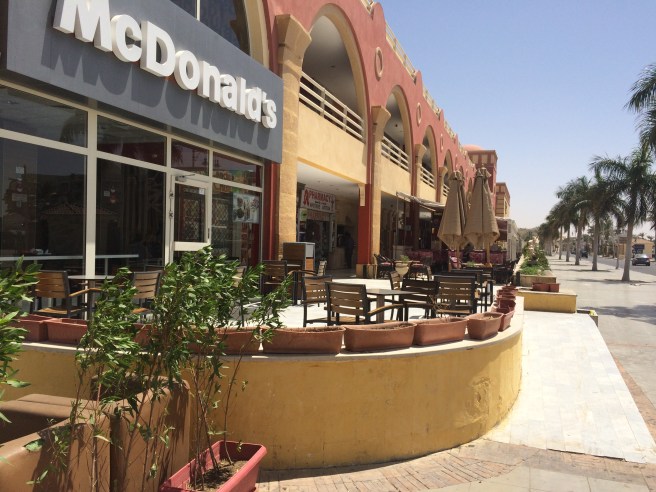
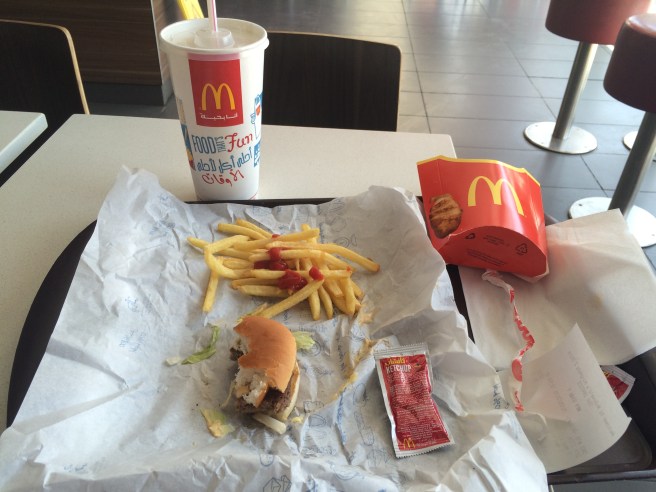
Just what is Mc D’s like in Egypt?

i was greeted by an Egyptian in a uniform that asked “How may I serve you.”

I was comforted, immediately.

After ordering a #1, I was asked “combo? ” and then “Supersize”?

Again, comforted.

image

I analyzed the meal.  Tastes like beef.  From where?

India?


“Do you ever serve Mc Rib?  You know, pork ribs”.  

I was srared at blankly.  I guess not.

Good fries.

Her Hajab

Her Hajab

image

Alexandria looks cleaner, more prosperous and much more western than Cairo and the Upper Nile cities of Luxor and Aswan. Traffic is orderly, not chaotic – other than the horns. It reminded me of my one and only visit to Newark, New Jersey 20 years ago. Lots of horn. The cars look newer, larger and in much better shape than in Cairo and everywhere else. They do not have as many scrapes, scratches and dings. There are lots of cabs.

On the highway north out of Cairo we passed the toll booth and were soon on a four lane each way divided freeway. The right lane was to go 80 km/h, the next over 90 km/h, the next 110 km/h and the far left lane was posted for going 120 km/h. Some cars went much faster.

The freeway was nicer than any of the freeways in Oregon or Washington really better than any western state that I have been in. Four lane freeway for about 100 km.

There are many fewer men wearing traditional Egyptian clothing. It reminds me of Trabzon, Turkey, on the Black Sea. Alexandria lacks the trash and chaos of Cairo and Luxor. But you still might see an occasional horse-drawn cart go down the street, with a man at the reins, carrying fruit, vegetables, eggs or alfalfa.

After uploading the several previous blog entries, I walked down to the lobby to listen to piano music. There was no music. I went to the desk and asked the desk agent where I could have a beer. She replied ‘upstairs and they have a complementary light dinner.’

I walked up the marble staircase to the first floor, down a long wide hallway with doors 10 feet high and 18 foot high ceilings.

I was greeted as I entered. I felt informal. He was dressed formally.

image

Alone in my room, earlier, after a long and tedious decision process, I planned what I would wear to dinner and how I would do my hair. Sandals, my hair down with a slight twist and a flip.

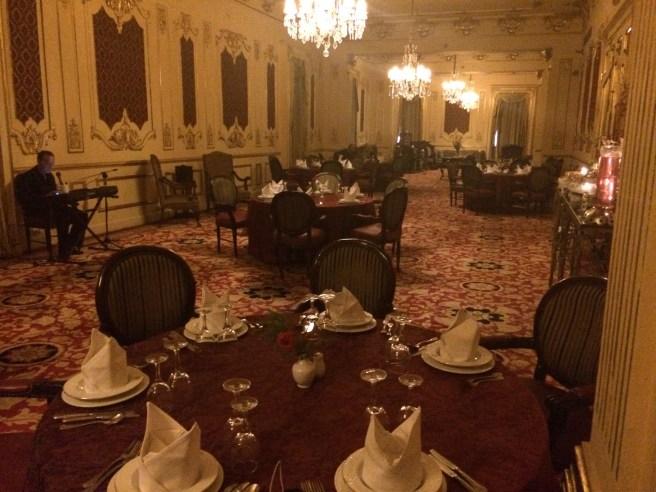
He showed me the salad bar. I asked ‘Can I set anywhere?’ and he affirmed. It was a tough decision. I sat in the corner so I could see the entire seating area. I could not see the Muslim couple. There were 15 tables with 6 chairs at each table and all were empty. Just me in the far corner staring at a sea of empty tables and chairs.

Ate salad, cheese, no bread, and had a Stella. Gold filigree was everywhere, high ceilings, very formal and french feeling. Music was terrible. Soapy western soundtrack music, being played by a guy to my left with basically an enhanced ipod-keyboard-canned-soundtrack-playing machine. The Muslim couple departed. It was just me and the DJ. I wondered if he had any Dire Straight he could cue up for me.

He played ‘Just The Two Of Us’. (OK, if he did not, he should have).

And then more soapy instrumental music with flutes, harps to an electronic accompaniment. The ‘Theme to Godfather’, ‘Feelings’, ‘I Need You’ by the band Bread. He stopped and took a short break. I almost applauded. He started up again.

I quickly left, but not before a small piece of chocolate cake.

Taking a beer with me, I walked downstairs and had a seat a large window in the lobby about 4 feet above the sidewalk and the 2 lanes of one way traffic.  I watched people and cars.  The piano guy appeared.  There was one after all.    People walked past and stared. I made sure they could see my ponytail.  After 20 minutes for his last tune he played ‘Hit The Road Jack’.  Really.

There are few men wearing the traditional Egyptian gallibeya. Fewer women fully covered by the hajib; most wore headscarfs and some wore western jeans.

I found this online from the Quran:

Say to the believing men that they should lower their gaze and guard their modesty: that will make for greater purity for them: And Allah is well acquainted with all that they do. And say that the believing women that they should lower their gaze and guard their modesty that they should not display their beauty and ornaments except what (must ordinarily) appear thereof; that they should draw their veils over their bosoms and not display their beauty except to their husbands, their fathers, their husband’s fathers, their sons, their husbands’ sons, their brothers or their brothers’ sons, or their sisters’ sons, or their women, or the slaves whom their right hands possess, or male servants free of physical needs, or small children who have no sense of the shame of sex; and that they should not strike their feet in order to draw attention to their hidden ornaments. ‘And O ye Believers! turn ye all together towards Allah, that ye may attain Bliss.’

— Sura 24 (An-Nur), ayat30-31, Qur’an[1]


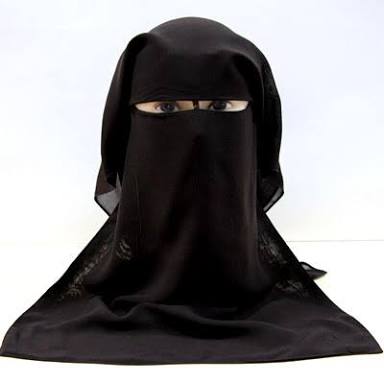
One young woman in a full hajib stared at me, sitting in the window, as she walked past. She looked directly at me from her little slit to the outside world.  Our eyes met.

Where I was sitting, I felt like a prostitute in a window in the red light district of Amsterdam.

image

She continued her stare as she walked past. I smiled, winked and licked my lips.

She looked away but I think she smiled under her hijab.

 
Hope you had a chuckle. I enjoyed writing it.

Namaste


My Rooms

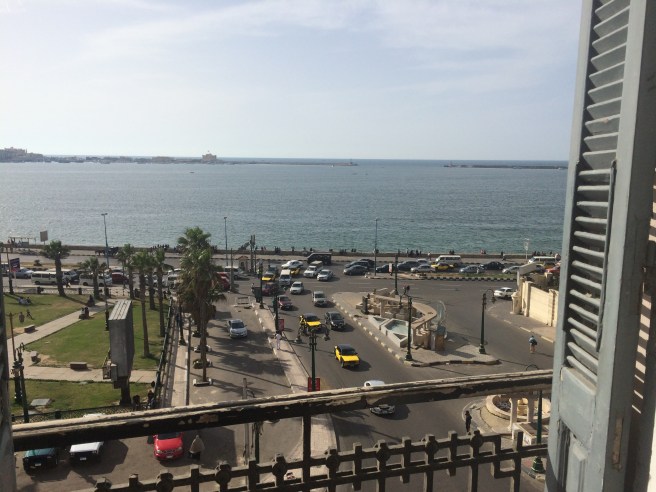
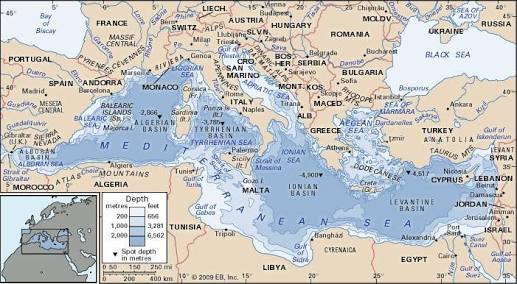
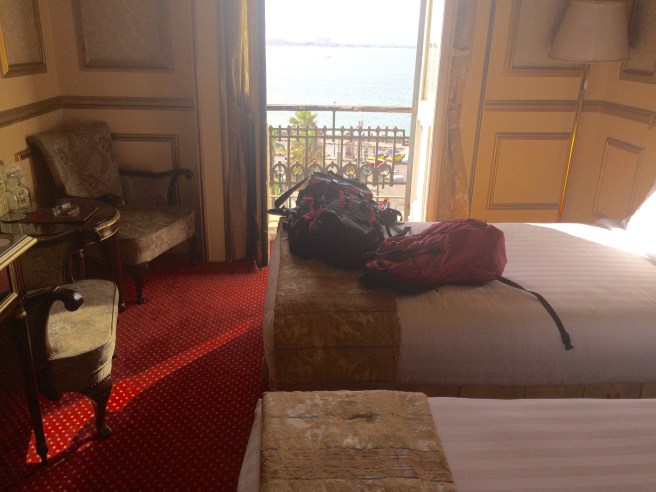
From my hotel room I overlook the seawall and the walking area along the Med in Alexandria.

image

It is called ‘The Corniche’, though it does not fit the dictionary definition. It is a harbour; there is no steepness to the land side, only the city buildings are high.

The seawall is lined with people – groups of people about 10 or 15 feet apart. There are lovers, friends, families, children- all sorts and types of groups of people space every 15 feet along the length of the entire visible seawall which winds around the harbor of Alexandria. The seawall and the walkway curves several miles to the east and several miles to the west.

There’s a constant cacophony of horn honking and in any single second you will you will hear five or six car horns. And then you hear a horse whinny. And then the evening call to prayers.  But you always hear horns, many types, tones, and duration.  Short honks mean ‘I am here’ and a long horn means ‘Get moving.’  All  the cars seem to be driving safely, respectively, (unlike Cairo and Luxor) and there is not anyone screaming and hollering- just honking their horn to get someones attention or tell them ‘Look out because here I come.’

After checking in, I chose to not go out tonight with Moro, Kevin, Linda, Matthew and two of Moro’s sisters, their husbands and their children and two additional friends, their wives and their children. In total there about 20 people here in Alexandria that Moro invited.  It is an army!!  He has a wonderful extended family and they spend lots of time together.

I wanted my solo time. I need it like sleep. I am a solo traveler. A chance to sit, write, listen, look, blog, email, plan Morocco, read about Alexandria. I needed time alone in Alexandria rather than along with the group tonight.

I really had a wonderful time last night at tomorrow’s home. We had a great dinner, about 20 of us.  With 6 sisters (one in the US) and a brother, he has a large family network, as do most Egyptians. A giant contrast to me.

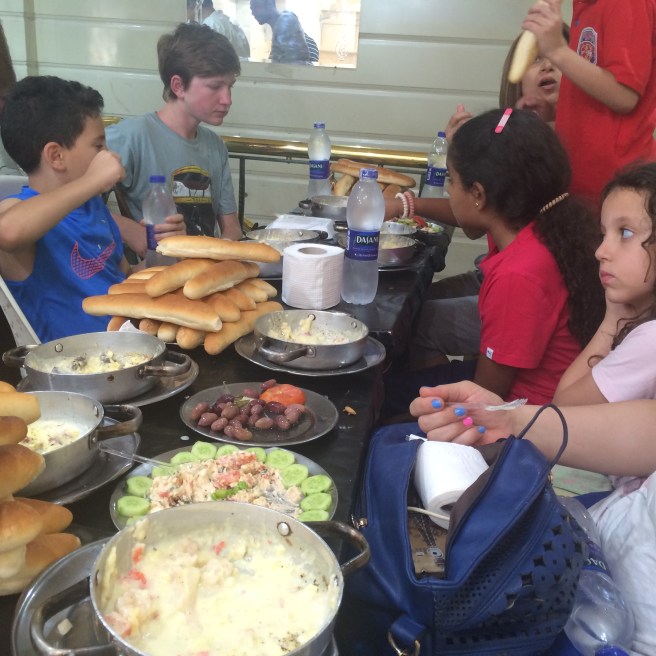
We had a great lunch today when we arrived in Alexandria –  all types of fondu – some with pastrami or seafood or beef sausage, fresh vegies, olives, bread. It was a hoot, with all of us sitting together, reaching, dipping, laughing, talking, taking pics, enjoying. Men, women, teens, little children and 1 older solo traveling man.

My room is on the third floor and I can see most of the harbor of Alexandria from the balcony. There is a piano bar downstairs from 7-10, and I will be there shortly.

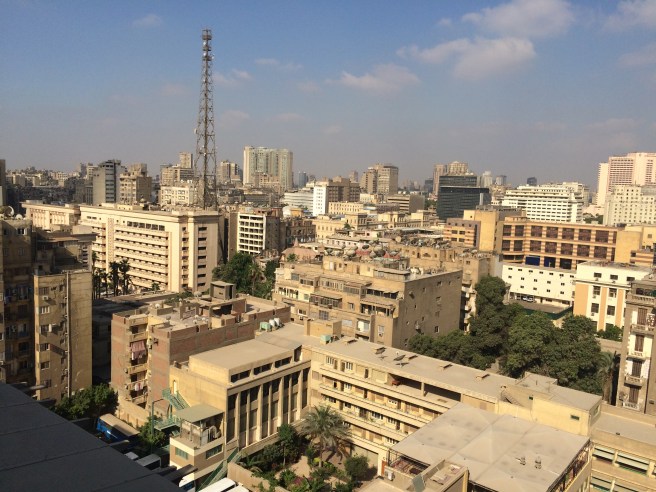
We leave Alex tomorrow and I will return to my room in downtown Cairo. A great place, on the 12th floor with access to the rooftop on the 13th floor. It is a very safe place since because it so so well isolated. It is 5 blocks from Tahrir Square and 8 blocks from the Egyptian Musuem, which I may revisit. The room includes breakfast; the owner has 2 dogs, pets, not like most dogs in Egypt which are treated like chickens. Most dogs are not pets.

All is good; I am having a wonderful time. Moro is the most hospitable man. The world would be a better place with more Moro’s.

Will rise early, walk along the seawall several miles in the early morning, the meet up with the troop and go to the Alexandria Library (the lighthouse that was one of the seven wonders of the ancient world is gone) and some Roman ruins. Alex has a very, very rich history and I plan on reading more about it tonight.

image

Wiki says:

Alexandria was founded by Alexander the Great in April 331 BC as Ἀλεξάνδρεια (Alexandria). Alexander’s chief architect for the project was Dinocrates. Alexandria was intended to supersede Naucratis as a Hellenistic center in Egypt, and to be the link between Greece and the rich Nile valley.

Alexandria was the intellectual and cultural center of the ancient world for some time. The city and its museum attracted many of the greatest scholars, including Greeks, Jews and Syrians. The city was later plundered and lost its significance.[3]

Just east of Alexandria (where Abu Qir Bay is now), there was in ancient times marshland and several islands. As early as the 7th century BC, there existed important port cities of Canopus and Heracleion. The latter was recently rediscovered under water.

An Egyptian city, Rhakotis, already existed on the shore also, and later gave its name to Alexandria in the Egyptian language (Egyptian *Raˁ-Ḳāṭit, written rˁ-ḳṭy.t, ‘That which is built up’). It continued to exist as the Egyptian quarter of the city. A few months after the foundation, Alexander left Egypt and never returned to his city. After Alexander’s departure, his viceroy, Cleomenes, continued the expansion. Following a struggle with the other successors of Alexander, his general Ptolemy succeeded in bringing Alexander’s body to Alexandria, though it was eventually lost after being separated from its burial site there.[4]

Although Cleomenes was mainly in charge of overseeing Alexandria’s continuous development, the Heptastadion and the mainland quarters seem to have been primarily Ptolemaic work. Inheriting the trade of ruined Tyre and becoming the center of the new commerce between Europe and the Arabian and Indian East, the city grew in less than a generation to be larger than Carthage. In a century, Alexandria had become the largest city in the world and, for some centuries more, was second only to Rome. It became Egypt’s main Greek city, with Greek people from diverse backgrounds.[5]

Alexandria was not only a center of Hellenism, but was also home to the largest urban Jewish community in the world. The Septuagint, a Greek version of the Tanakh, was produced there. The early Ptolemies kept it in order and fostered the development of its museum into the leading Hellenistic center of learning (Library of Alexandria), but were careful to maintain the distinction of its population’s three largest ethnicities: Greek, Jewish, and Egyptian.[6]

In AD 115, large parts of Alexandria were destroyed during the Kitos War, which gave Hadrian and his architect, Decriannus, an opportunity to rebuild it. In 215, the emperor Caracalla visited the city and, because of some insulting satires that the inhabitants had directed at him, abruptly commanded his troops to put to death all youths capable of bearing arms. On 21 July 365, Alexandria was devastated by a tsunami (365 Crete earthquake),[7] an event annually commemorated years later as a “day of horror.”[8]


Namaste.


May 20, 2016. Alexandria.

Please, Relax……

Think more about my blog than the knownothings you watch on TV.

In the USA, people get shot by crazy Americans when going to baptist churches, to McDonalds or going with their girlfriend to see a new  Batman movie.

Dozens of first grade children were killed in a New Hampshire school a year ago and soldiers have been killed on army bases.

30,000 Americans are killed in car crashes annually and there are over 11,000 firearm homicides a year in the US, usually by someone they know.  Almost all of the killers are Americans.

Hundreds of Americans die every year when they fall down stairs in their own home.

Do you you tell your friends and family to be careful every time they go to church, to McDonalds, to a movie, drive to the store or just plain walk down a set of stairs?

Please do not implore me to be careful.  You should be careful in America.

I spent almost my entire career imploring people to “Be Safe.”  I think I understand the concepts of safety better than most people.  I have a fucking M.S. in Safety, for heaven’s sake – and this is not my first international rodeo.

I am having a wonderful time with the amazingly hospitable Egyptian people.

Stop watching the news.

imageimage


imageimage

From Alexandria, overloking the Mediterranean Sea, at 4:55 PM on May 20, 2016.


On walkabout,

abackpackandadaysack

Mr. Maybe

Osirius Hotel May 18, 2016

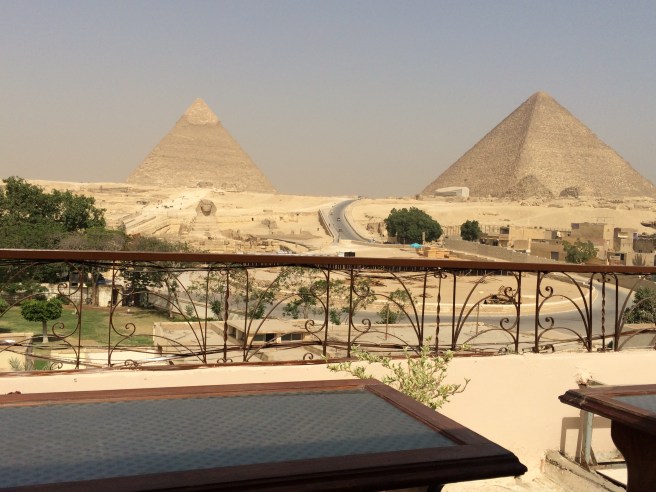
Awoke and had breakfast for the last time overlooking the pyramids on the roof of Pyramid View then set out for a short walk.

image

It was short walk-maybe 15 feet – until I saw the man that had arranged two evening carriage rides for me. We talked for 15 minutes then I walked another 50 feet and met Abdoul from Sphinx View. He calls me “Mr. Maybe” because every time he asks me about buying something from him, I honestly reply “Maybe”. I invited him for tea and a shisha in a café 2 blocks away.

Abdoul went to mid day prayers and I wandered the shops outside the entrance to the pyramids. Walking past the same cab driver that repeatedly, every day,  asks me “Taxi?”
I again said “No”.
He said “Again today, no taxi?”
Then the policeman, who recognized me, said to the cabbie “He lives here”.
I felt like a local. After 7 or 8 nights at Pyramid View I am recognized by the locals and have met and talked with many men.

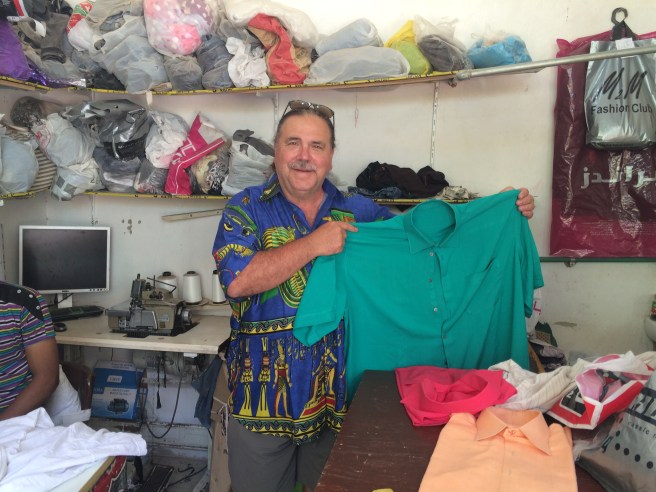
After prayers, Abdoul and I took a taxi to get my shirts, which are killer, but cut a bit bigger than the ones I bought in Luxor.

image

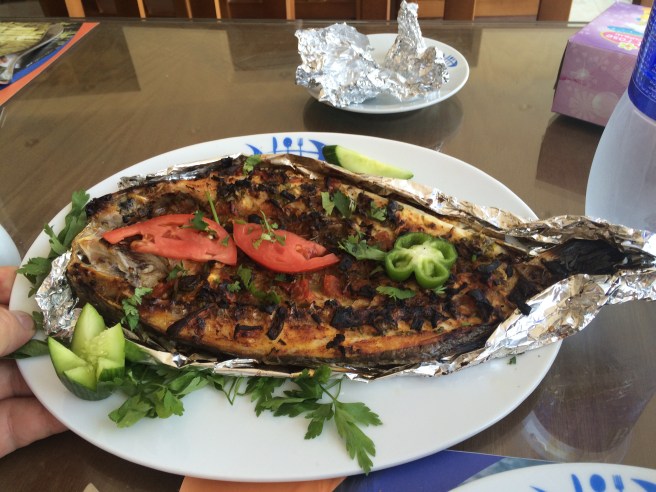
Had a nice fish lunch at a restaurant that I have been to four times now, just 3 blocks from Pyramid View.

image

Then back to PV for a shower and a ride from PV Abdou, to central Cairo, 4 blocks from Tahrir Square. Up on the 12th floor, in a nice room, I have a sweeping view of Cairo from the balcony. 

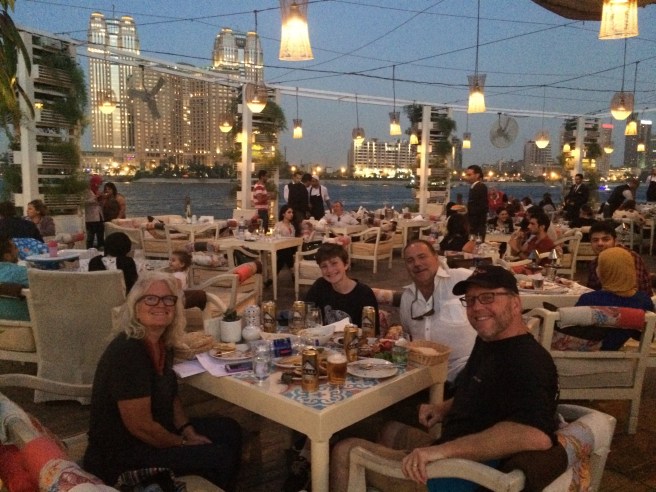
Quickly changed clothes then went downstairs to meet an Uber driver that Moro sent to pick me up. Off in 10 minutes, I met Moro, Kevin, his wife Linda and their son Matthew, 13 years old.

image

My good friend Moro.

Kevin, Linda and Matthew have been traveling for 10 months and have visited 30 countries. They will visit 10 more countries before they return to Portland, OR after relocating from SoCal. All their stuff is in storage.

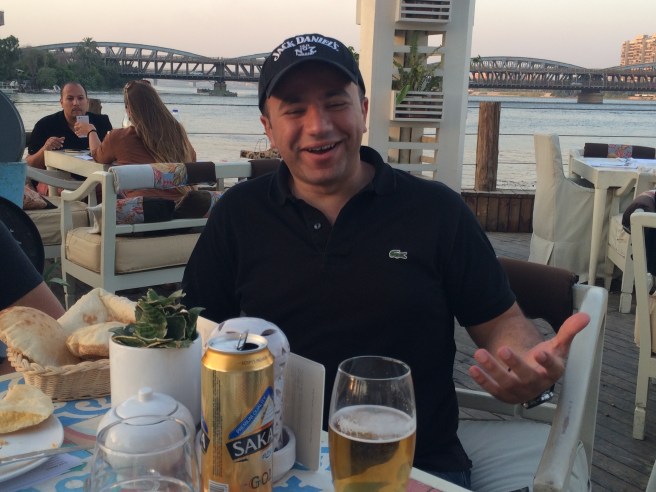
We had dinner and drinks in the same restaurant that Luis, Moro and I did several weeks ago.

image

Fantastic location, on an island in the middle of the Nile in downtown Cairo. We sat for 3 hours and talked travel.

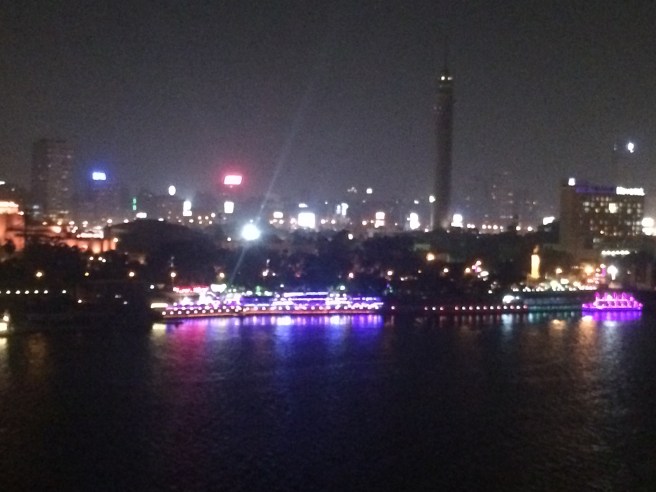
Then off to the 12th floor of the Kempinsky Hotel for drinks in the piano bar overlooking downtown Cairo. Spectacular sweeping views of the Nile and the heart of Cairo.

image

A great day. Busy. Never stopped after drinking morning tea on the streets of Giza.

Again, just to refresh everyone’s memory.  I met Moro on the terminal transfer bus in Vienna on day 1 of my walkabout.  Travelers are often blessed with meeting other travelers.

Time for bed.  12:45 AM.